Shadow work tarot: a guide and 5-card spread
Learn how to use tarot for shadow work safely. Explore useful prompts, a five-card spread, interpretation tips, and when to seek professional support.
Shadow work tarot is a self-reflection practice that uses card imagery to notice emotions, desires, and patterns you tend to hide, deny, or avoid. The aim is not to banish a “bad” part of yourself. It is to bring an excluded part into the conversation and choose a more conscious way to respond.
The cards cannot read your mind or reveal a clinical truth about your unconscious. They offer symbols and questions. You do the real work by comparing those images with the facts of your life, writing down what you notice, and turning insight into a realistic action. If reflective reading is new to you, begin with our guide to tarot for self-discovery.
What is shadow work?
The “shadow” is a concept associated with Carl Jung's analytical psychology. In plain language, it includes traits, feelings, and desires the conscious ego finds unacceptable and keeps out of view. It can also include positive qualities you learned to suppress, not only uncomfortable impulses. You can read the concise definition in the APA Dictionary of Psychology.
In ordinary life, shadow material may show up as an outsized reaction, a repeating pattern, or a quality you criticize intensely in someone else. It can also surface when you shrink your creativity, assertiveness, or ambition because you learned that those qualities were unwelcome.
Shadow work is the popular name for trying to recognize and integrate this material. In tarot practice, images become starting points for questions such as: “what does this card stir in me?”, “where have I lived this dynamic before?”, and “what part of me needs to be heard without running every decision?”.
How can tarot support shadow work?
Tarot can slow down automatic interpretations. A card places an image between you and the problem, giving you enough distance to look from another angle. This may help you:
- name a feeling that was showing up only as irritation or anxiety;
- notice the fear hiding beneath a defense;
- acknowledge needs you feel embarrassed to express;
- reclaim strengths you also learned to suppress;
- choose a more deliberate response to a repeating pattern.
Tarot cannot prove that an interpretation is true. Treat every reading as a reflection hypothesis, compare it with observable events, and let go of anything that does not fit. A consistent tarot journal helps you distinguish a momentary impression from a pattern that actually holds up over time.
How to prepare without turning the practice into fear
Set aside 20 to 30 minutes, choose a place where you feel safe, and keep a pen and paper nearby. Before shuffling, define one specific theme: a recent conflict, a recurring reaction, or a decision where you notice self-sabotage.
Use an open question that centers your own agency. For example:
“What am I not yet recognizing about my response to this situation, and how can I respond more consciously?”
Avoid loaded questions such as “what trauma explains everything?” or “who is to blame for how I feel?”. Do not use the cards to diagnose yourself or another person. Our guide to questions to ask tarot offers more useful ways to move from prediction toward clarity.
Before you begin, agree on three boundaries with yourself:
- I can end the reading at any time;
- I will not draw replacement cards just to erase an uncomfortable answer;
- I will not make an important decision from this spread alone.
A five-card shadow work tarot spread
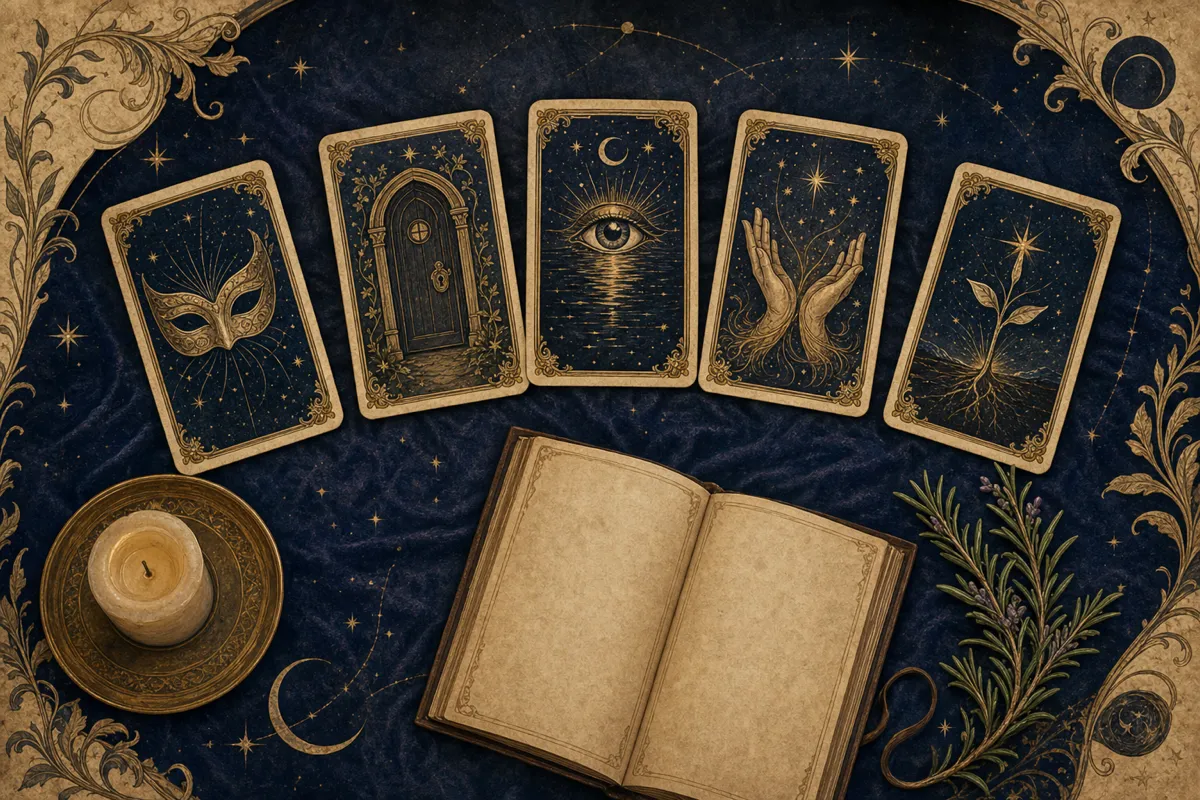
Place five cards from left to right. The illustration above represents the five roles through a mask, door, mirror, open hands, and seedling. You do not need to draw cards that resemble those pictures; each symbol is simply a reminder of that position's purpose.
| Position | Theme | Interpretation question |
|---|---|---|
| 1. The mask | What I show to protect myself | What role do I play in this situation? |
| 2. The locked door | What I avoid acknowledging | What feeling, desire, or boundary have I pushed away? |
| 3. The mirror | The root I can see today | When does this pattern appear, and what seems to trigger it? |
| 4. The open hands | The resource available to me | What quality can help me hold this without surrendering to the impulse? |
| 5. The seedling | Integration | What small action can turn this insight into a choice? |
Begin with what you can see: figures, gaze direction, color, movement, and the feeling the image evokes. Then consult the meanings of tarot cards and combine a card's meaning with the role of its position.
How to interpret shadow work cards without fatalism
Suppose the Moon appears at the locked door. Instead of deciding “something terrible is hidden,” ask which uncertainties you tend to fill with assumptions. If the Devil occupies the mirror, look at attachments, bargains, or habits that feel inevitable but still involve choice. If Strength appears as your resource, the way forward may be gentle firmness rather than aggressive control.
Intense cards are not evidence of trauma, danger, or evil. Death, the Tower, the Devil, and the Moon are layered symbols that require the context of your question. Our guide to difficult tarot cards helps you interpret them without turning imagery into threats.
Once you have considered every position, read the spread as a story:
- which symbols, numbers, or suits repeat?
- is there a contrast between the mask and the locked door?
- does the resource truly answer the pattern you found?
- is the fifth card's action small enough to complete?
If two cards appear to disagree, do not force a tidy answer. Explore the tension between them or use the guide to tarot card combinations. Ambivalence may be the most honest information in the spread.
12 shadow work tarot prompts
Use one prompt at a time with a one-card tarot spread, or choose one as the theme for all five positions.
- What part of myself do I try to make invisible so I will be accepted?
- What irritates me most here, and what does it touch in me?
- What need do I struggle to admit?
- Where do I confuse protection with withdrawal?
- What strength have I learned to make smaller?
- What do I gain from keeping this pattern, even while it limits me?
- What fear appears when I consider setting a boundary?
- What impossible expectation do I place on myself?
- What might I be projecting onto someone else?
- What feeling needs to be felt rather than solved immediately?
- What resource do I already have for moving through this discomfort?
- What action would represent integration rather than punishment?
How to journal and integrate the reading
Divide a page into three sections: what the card shows, what facts support or challenge my reading, and what I will do next. This keeps a symbolic impression from turning into an automatic certainty.
One useful outside reference is the NHS thought record exercise, which organizes a situation, feelings, thoughts, and evidence. It is not a tarot technique, but it supports a sound principle: check an interpretation against evidence before accepting it.
Close the deck and choose one simple action for the next 24 hours: draft a conversation you need to have, practice a boundary, apologize, rest, or observe a trigger without reacting immediately. Return to your notes after a few days and record what changed. Insight without integration becomes just another interesting story.
When to stop and seek professional support
Stop the practice if it triggers panic, dissociation, traumatic memories that feel hard to regulate, urges to punish yourself, or a compulsive need to keep drawing cards. Put the deck away, notice your surroundings, breathe, and contact someone you trust. If distress is intense or persistent, speak with a mental health professional or an emergency service in your area.
Tarot does not diagnose or treat trauma, and it cannot replace psychotherapy. It also should not make medical, legal, or financial decisions for you. Learn more about those boundaries in tarot and emotional health and tarot reading ethics.
What makes shadow work genuinely integrative
The goal is not to approve of every impulse or excuse harmful behavior. Integration means recognizing that something exists, understanding what it tries to protect, and consciously choosing how you act. You remain responsible for your boundaries and behavior.
Do fewer readings and allow more time for observation. A spread that increases agency, compassion, and your ability to act has done its job. If you prefer a responsible guided interpretation for your situation, you can take the personalized reading quiz.
Frequently asked questions
What is shadow work in tarot?+
It is a reflection practice that uses card imagery to notice emotions, desires, and patterns you tend to avoid or hide. Tarot provides symbolic prompts; it does not diagnose the unconscious or replace therapy.
What is the best tarot card for shadow work?+
There is no single best card. The Moon, the Devil, the High Priestess, the Hermit, and Strength can open useful reflections, but any card may reveal a blind spot when read in the context of your question.
Can I do shadow work tarot on my own?+
Yes, as long as you begin with manageable topics, write without judging yourself, and stop if you become overwhelmed. Trauma, crisis, or emotions that feel hard to regulate deserve support from a mental health professional.
How many cards should I use for a shadow work spread?+
One card is enough for a short reflection. For more depth without losing focus, this guide's five-card spread explores the mask, the avoided pattern, its perceived root, a resource, and an integration step.
How often should I do a shadow work tarot spread?+
Once a month or when a concrete pattern repeats is usually enough. Avoid asking the same question again on the same day; give yourself time to journal, act, and observe what changes.